Salinity
Salinity Modifiers
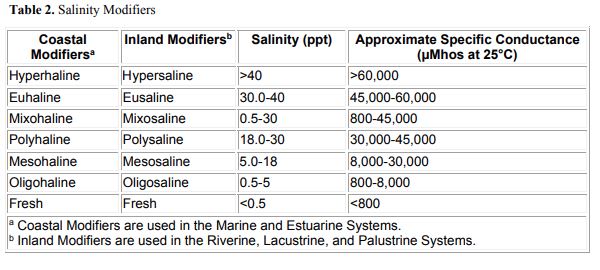
Differences in salinity are reflected in the species composition of plants and animals. Many authors have suggested using biological changes as the basis for subdividing the salinity range between sea water and fresh water (Remane and Schlieper 1971). Others have suggested a similar subdivision for salinity in inland wetlands (Moyle 1946; Bayly 1967; Stewart and Kantrud 1971). Since the gradation between fresh and hypersaline or hyperhaline waters is continuous, any boundary is artificial, and few classification systems agree completely. The salinity classification adopted here for both coastal and inland waters is a modified version of the Venice System (1959), which was originally proposed at an international “Symposium on the Classification of Brackish Waters.”
Estuarine and Marine waters are a complex solution of salts, dominated by sodium chloride (NaCl). The term haline is used to indicate the dominance of ocean salt. The relative proportions of the various major ions are usually similar to those found in sea water, even if the water is diluted below sea water strength. Dilution of sea water with fresh water and concentration of sea water by evaporation result in a wide range of recorded salinities in both surface water and interstitial water within the substrate.
The salinity of inland water is dominated by four major cations, calcium (Ca), magnesium (Mg), sodium (Na), and potassium (K); and three major anions, carbonate (C03), sulfate (SO4), and chloride (Cl) (Wetzel 1975). Salinity is governed by the interactions between precipitation, surface runoff, groundwater flow, evaporation, and sometimes evapotranspiration by plants. The ionic ratios of inland waters usually differ appreciably from those in the sea, although there are exceptions (Bayly 1967). The great chemical diversity of these waters, the wide variation in physical conditions such as temperature, and often the relative impermanence of surface water, make it extremely difficult to subdivide the inland salinity range in a meaningful way. Bayly (l967) attempted a subdivision on the basis of animal life; Moyle (1945) and Stewart and Kantrud (1971) have suggested two very different divisions on the basis of plant life.
The term saline is used to indicate that any of a number of ions may be dominant or codominant. These salinities are expressed in units of specific conductance as well as percent salt (Ungar 1974) and they are also covered by the salinity ranges in Table 2.
Created with the Personal Edition of HelpNDoc: Free Kindle producer