Riverine (R)
SYSTEM = RIVERINE
(R) Riverine (Rivers, creeks, and streams)
Definition:
The Riverine System includes all wetlands and deepwater habitats contained within a channel, with two exceptions:
1. Wetlands dominated by trees, shrubs, persistent emergents, emergent mosses,or lichens, and
2. habitats with water containing oceanderived salts in excess of 0.5%.
A channel is an open conduit either naturally or artificially created which periodically or continuously contains moving water, or which forms a connecting link between two bodies of standing water.
Limits:
The Riverine System is bounded on the landward side by upland, by the channel bank (including natural and man-made levees), or by wetland dominated by trees, shrubs, persistent emergents, emergent mosses, or lichens. In braided streams, the system is bounded by the banks forming the outer limits of the depression within which the braiding occurs.
The Riverine System terminates at the downstream end where the concentration of ocean-derived salts in the water exceeds 0.5% during the period of annual average low flow, or where the channel enters a lake. It terminates at the upstream end where tributary streams originate, or where the channel leaves a lake. Springs discharging into a channel are considered part of the Riverine System.
Where a river enters a lake, the extension of the Lacustrine shoreline across the mouth of the river forms the Riverine/Lacustrine break. Oxbow lakes are placed in the Palustrine or Lacustrine Systems unless they are connected to a Riverine System by an open channel at both ends, either permanently or intermittently. Ruin-of-the-river dams should be handled in the same manner as described above, with the Lacustrine System extending upstream to the contour approximating the normal spillway or pool elevation.
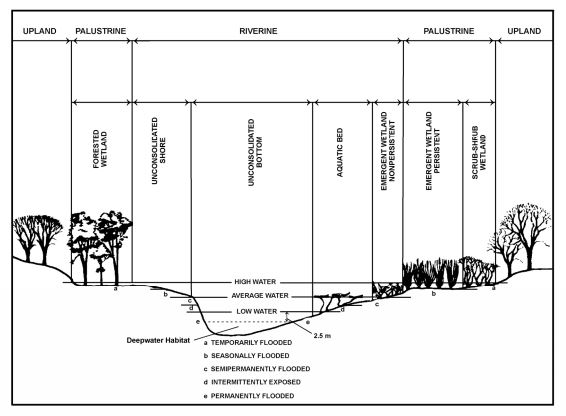
Description:
Water is usually, but not always, flowing in the Riverine System. Upland islands or Palustrine wetlands may occur in the channel, but hey are not included in the Riverine System. Palustrine Moss-LichenWetlands, Emergent Wetlands, Scrub-Shrub Wetlands, and Forested Wetlands may occur adjacent to the Riverine System, often on a floodplain. Many biologists have suggested that all the wetlands occurring on the river floodplain should be a part of the Riverine System because they consider their presence to be the result of river flooding. However, we concur with Reid and Wood (1976:72,84) who stated, "The floodplain is a flat expanse of land bordering an old river . . . Often the floodplain may take the form of a very level plain occupied by the present stream channel, and it may never, or only occasionally, be flooded . . . It is this subsurface water [the ground water] that controls to a great extent the level of lake surfaces, the flow of streams, and the extent of swamps and marshes."
Created with the Personal Edition of HelpNDoc
Subsystems:
The Riverine System is divided into four Subsystems: the Tidal, the Lower Perennial, the Upper Perennial, and the Intermittent. Each is defined in terms of water permanence, gradient, substrate, and the extent of floodplain development. The Subsystems have characteristic flora and fauna (see Illies and Botosaneau 1963; Hynes 1970; Reid and Wood 1976). All four Subsystems are not necessarily present in all rivers, and the order of occurrence may be other than that given below.
Tidal (1) - This Subsystem extends from the upstream limit of tidal fluctuations down to the upper boundary of the Estuarine System, where the concentration of ocean-derived salts reaches 0.5 ppt during the period of average annual low flow. The gradient is low and water velocity fluctuates under tidal influence. The stream bottom is mainly mud with occasional patches of sand. Oxygen deficits may sometimes occur and the fauna is similar to that in the Lower Perennial Subsystem. The floodplain is typically well developed.
Lower Perennial (2) - This Subsystem is characterized by a low gradient. There is no tidal influence, and some water flows all year, except during years of extreme drought. The substrate consists mainly of sand and mud. Oxygen deficits may sometimes occur. The fauna is composed mostly of species that reach their maximum abundance in still water, and true planktonic organisms are common. The gradient is lower than that of the Upper Perennial Subsystem and the floodplain is well developed.
Upper Perennial (3) - This Subsystem is characterized by a high gradient. There is no tidal influence, and some water flows all year, except during years of extreme drought. The substrate consists of rock, cobbles, or gravel with occasional patches of sand. The natural dissolved oxygen concentration is normally near saturation. The fauna is characteristic of running water, and there are few or no planktonic forms. The gradient is high compared with that of the Lower Perennial Subsystem, and there is very little floodplain development. Intermittent. This Subsystem includes channels that contain flowing water only part of the year. When the water is not flowing, it may remain in isolated pools or surface water may be absent.
Intermittent (4) - This Subsystem includes channels that contain flowing water only part of the year. When the water is not flowing, it may remain in isolated pools or surface water may be absent.
Classes: Rock Bottom, Unconsolidated Bottom, Aquatic Bed, Streambed, Rocky Shore, Unconsolidated Shore, and Emergent Wetland (nonpersistent)
Created with the Personal Edition of HelpNDoc: Single source CHM, PDF, DOC and HTML Help creation