Marine (M)
SYSTEM = MARINE
(M) Marine : (Open ocean and associated coastline)
Definition:
The Marine System describes open ocean or high-energy coastlines with salinities exceeding 30 ppt and little or no dilution except outside the mouths of estuaries. Shallow coastal indentations or bays without appreciable freshwater inflow; and coasts with exposed rocky islands, that provide the mainland with little or no shelter from wind and waves, are also considered part of the Marine system because they generally support typical marine biota.
Limits:
The Marine System extends from the outer edge of the continental shelf shoreward to one of three lines:
1. The landward limit of tidal inundation (extreme high water of spring tides), including the splash zone from breaking waves;
2. The seaward limit of wetland emergents, trees, or shrubs;
3. The seaward limit of the Estuarine System, where the limit is determined by factors other than vegetation.
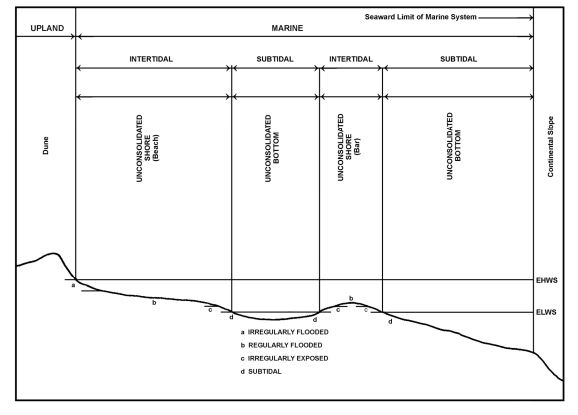
Description:
The distribution of plants and animals in the Marine System primarily reflects differences in four factors:
1. degree of exposure of the site to waves;
2. texture and physicochemical nature of the substrate;
3. amplitude of the tides; and
4. Latitude, which governs water temperature, the intensity and duration of solar radiation, and the presence or absence of ice.
Subsystems:
Subtidal (1) - The substrate in these habitats is continuously covered with tidal water (i.e., located below extreme low water).
Intertidal (2) - The substrate in these habitats is flooded and exposed by tides; includes the associated splash zone.
Classes: Rock Bottom, Unconsolidated Bottom, Aquatic Bed, Reef, Rocky Shore, and Unconsolidated Shore.
Created with the Personal Edition of HelpNDoc: Full-featured Kindle eBooks generator